
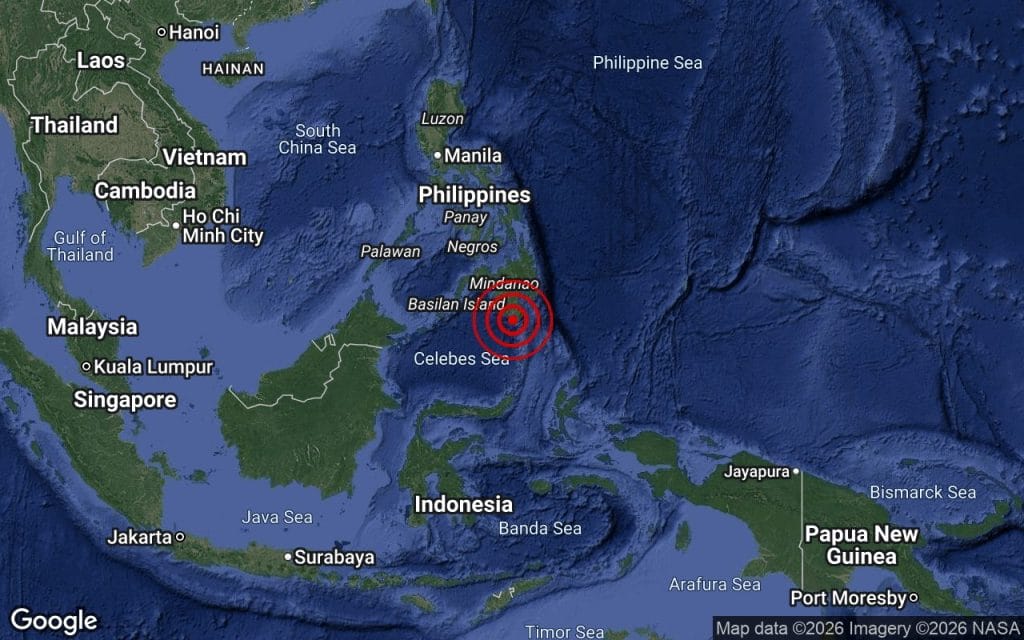
A powerful and deeply destructive magnitude 7.8 earthquake struck the southern coast of Mindanao, Philippines, early Monday morning, triggering urgent coastal evacuations, cutting power grids, and leaving a trail of severe structural damage in major urban hubs.
According to the Philippine Institute of Volcanology and Seismology (PHIVOLCS), the violent tremor hit at 07:37 AM local time, centered offshore just south of Sarangani province. The United States Geological Survey (USGS) mapped the depth of the quake at 55.2 km (34.3 miles). It registers as the strongest earthquake to strike the Philippines in over three decades, drawing immediate, widespread comparison to the country’s historic 1990 Luzon disaster.
Key Seismic Data & Impact Statistics
The sheer scale of the event is coming into focus as emergency disaster risk management agencies compile initial field statistics:
| Metric | Official Verified Details |
| Magnitude | Mw 7.8 (Upgraded from an initial 7.0 report) |
| Maximum Intensity | Intensity VIII (Very Destructive) on the PHIVOLCS scale |
| Population Exposed | Approx. 1.07 million people in the severe shaking zone |
| Aftershock Activity | Over 16+ aftershocks measuring greater than or equal to Mw 4.0 |
| Strongest Aftershock | Registered at a severe Mw 6.5 later in the day |
Tsunami Threat Triggers Mass Evacuations
Immediately following the main shock, PHIVOLCS and the Pacific Tsunami Warning Center issued critical alerts for the surrounding marine borders. Coastal residents across nine provinces—including Sarangani, Davao Occidental, Tawi-Tawi, and South Cotabato—were strictly advised to flee to high ground immediately.
-
Wave Heights: Tsunami waves up to 3 meters (10 feet) were projected as possible along local Philippine coastlines.
-
Regional Reach: Tsunami wave variations up to 1 meter (3 feet) triggered alerts as far south as neighboring coastlines in Indonesia and Malaysia.
Officials have continuously urged the suspension of all maritime, surfing, fishing, and boating activities as sea level disturbances can fluctuate violently for hours following an offshore thrust earthquake of this magnitude.
Widespread Structural Collapses in General Santos City
The commercial hub of General Santos City, home to more than 700,000 residents, appears to have borne the brunt of the land-based structural damage. Terrifying footage and photos from the ground show buildings partially pancaked, and debris crushing vehicles parked on city streets.
Among the major structural failures reported so far:
-
Educational Institutions: A multi-story building at the Notre Dame of Dadiangas University (pictured above) sustained a major partial collapse. Fortunately, school administrations have reported that no students were harmed.
-
Commercial Units: A four-story commercial complex housing local radio broadcasting studios and popular local eateries suffered a catastrophic lower-level collapse, forcing early-morning workers to scramble for safety.
-
Infrastructure Disruptions: Major electrical grids, water lines, and internet services were knocked out completely across Koronadal and neighboring municipalities. General Santos International Airport temporarily halted all flights to run comprehensive structural assessments on runways and terminal buildings.
Casualties and Response
Because the earthquake struck just before typical office and school hours, massive casualties appear to have been averted, though the situation remains fluid. The National Disaster Risk Reduction Management Council (NDRRMC) has so far confirmed at least 3 to 5 fatalities and multiple injuries in the Soccsksargen region, with search and rescue teams actively clearing debris in low-lying zones.
Philippine President Ferdinand “Bongbong” Marcos Jr. issued an immediate directive mobilizing the Department of Social Welfare and Development alongside the Office of Civil Defense to rapidly deploy emergency first responders, food packs, and satellite communication arrays to the isolated southern provinces.
Safety Reminder for Residents: With aftershocks continuing to cross the Mw 6.0 threshold, search units advise everyone in southern Mindanao to inspect structures for cracks before re-entering, watch out for falling interior objects, and strictly avoid steep hillsides prone to landslides.
